The Ultimate Guide to Park City Tree Preservation: Protecting Your High-Altitude Landscape
If you’ve lived in Park City for more than a season, you’ve likely noticed patches of rust-colored needles appearing on the mountainsides. In 2026, we are witnessing an aggressive cycle of the Douglas-fir beetle and the Mountain Pine beetle.
Why Park City Trees are Vulnerable
High-altitude trees in the 84060 and 84098 areas face a “perfect storm” of stressors:
- Drought Stress: Even with heavy winter snow, our summers are increasingly arid, weakening the tree’s natural ability to produce “pitch” (the sap used to push beetles out of the trunk).
- Stand Density: In neighborhoods like Summit Park and Pine Meadow, trees are often overcrowded, allowing beetles to hop from one host to the next with ease.
- The “Ticking Time Bomb”: Once you see “boring dust” (resembling coffee grounds) at the base of your tree, it is often too late.
The “Gold Standard” Defense
We utilize the industry’s most rigorous protection protocol—the 2007 Gold Standard. While budget trimmers might offer topical sprays that wash away with the first mountain rain, we use precision trunk injections of Emamectin Benzoate.
Expert Tip: Our injections provide 2 years of guaranteed protection. By bypassing the soil and bark entirely, the medicine stays within the tree’s vascular system, ensuring that any beetle that attempts to bore into your tree is neutralized immediately.
Signature Shade Tree Pruning: Engineering for Snow Load
In the Park City valley, a “pretty” tree isn’t necessarily a “safe” tree. Our Signature Shade Tree Pruning is a structural engineering process designed to prepare your canopy for the 300+ inches of snow we see in a typical winter.
Addressing Codominant Leaders
Many native trees grow with “codominant leaders”—two main trunks of equal size competing for dominance. In the arboriculture world, this creates a “V-shaped” union characterized by included bark.
- The Risk: These unions lack a solid wood connection. When a heavy, wet October snow hits, the leverage of that weight acts like a wedge, splitting the tree down the middle.
- The Solution: We identify these weak points early. Through subordination pruning, we reduce the weight of one leader, encouraging the other to become the dominant, stronger trunk.
Canopy Thinning & The “Sail Effect”
Park City is known for its erratic canyon winds. A dense, unpruned canopy acts like a sail on a boat. Without proper thinning, these winds can snap mature limbs or even uproot the entire tree. We strategically thin the “interior” of the canopy to allow wind and light to pass through, reducing the risk of catastrophic failure without sacrificing the tree’s natural aesthetic.
Scientific Bio-Injections: Overcoming Alkaline Soil
One of the biggest misconceptions in Park City landscaping is that “mountain soil” is naturally rich. In reality, much of the Wasatch Back is characterized by high-pH, alkaline soil that “locks out” essential nutrients.
The Problem: Iron Chlorosis
Have you noticed your Maples or Aspens turning a sickly yellow while the veins stay green? This is Iron Chlorosis. The iron is in the soil, but because the pH is too high, the tree cannot absorb it.
The “Arbor Services” Prescription
We don’t believe in generic fertilizers. Our proprietary Scientific Bio-Injection is a high-density blend of:
- Chelated Iron & Manganese: Specifically formulated to stay “available” to the tree even in high-pH conditions.
- 16-16-16 Mineral Base: A balanced “slow-drip” of Nitrogen, Potassium, and Phosphorus.
- Active Mycorrhizae: Beneficial fungi that rebuild the soil’s biological health, extending the reach of the feeder roots.
We calculate every dose based on the tree’s DBH (Diameter at Breast Height), ensuring your tree gets exactly what it needs and nothing it doesn’t.
Root Flare Excavation: The “Silent Killer”
The single most common cause of tree death in Park City residential developments isn’t a bug or a fungus—it’s Deep Planting.
The “Nursery Trap”: Why Most Trees are Born to Fail
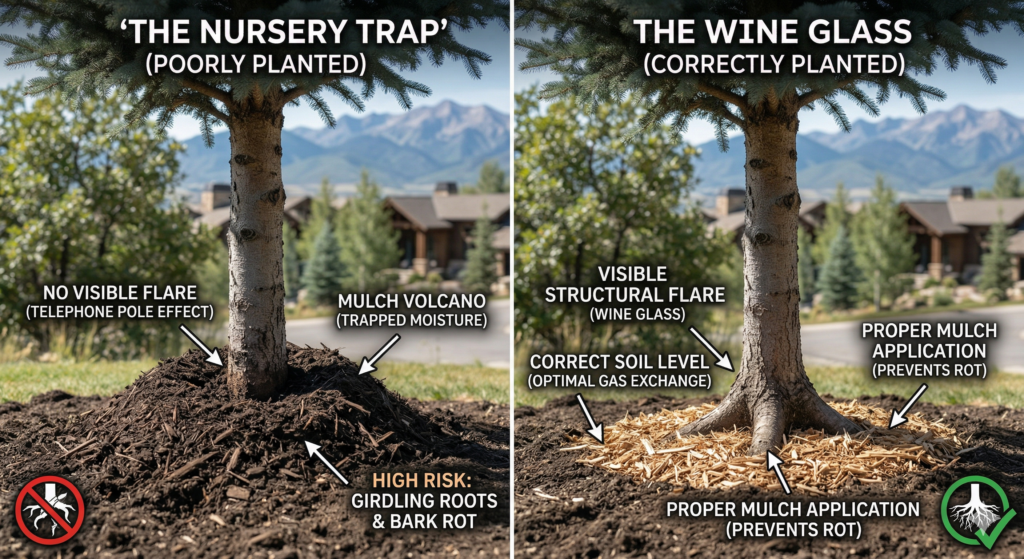
The tragedy of a buried root flare often begins years before the tree ever reaches your property—a phenomenon known as the “Nursery Trap.” During the production process, young trees are frequently planted too deep in their containers or “potted up” with extra soil to provide stability during transport. By the time a landscaper installs that tree at your Park City home, the true root flare is already buried four to eight inches deep. Most installers simply match the new hole to the height of the soil in the pot, unknowingly interring the tree in a “structural grave.” This mistake traps moisture against the trunk bark, leading to rot and the development of Girdling Roots that act like a slow-motion noose, strangling the tree just as it reaches maturity.
The “Telephone Pole” vs. The “Wine Glass” Test
To see if your landscape is at risk, perform a simple visual check: Look at where your tree meets the soil. If the trunk enters the ground straight and narrow—like a “Telephone Pole” or a 4×4 post—the root flare is buried and the tree is in danger. A healthy, properly planted tree should resemble the base of a “Wine Glass,” featuring a visible, flared buttress that is exposed to the air. With our 90+ years of experience, we specialize in reversing these nursery-born mistakes. Using specialized pneumatic tools, we perform surgical excavations to uncover the flare and prune away strangling roots, restoring the tree’s natural foundation and adding decades to its life.
What is a “Mulch Volcano”?
When trees are planted too deep, or when mulch is piled high against the trunk (the “mulch volcano”), the Root Flare—where the trunk meets the roots—is buried.
- The Result: Moisture is trapped against the bark, leading to rot. Even worse, the tree may develop Girdling Roots that slowly strangle the trunk, cutting off the flow of water and nutrients.
Our Restoration Process
Using specialized pneumatic tools, we perform Root Flare Excavation to uncover the tree’s natural foundation. We remove circling roots and restore the “flare” to the surface. This single service can add 50 years to the life of an embattled estate tree.
5. The Park City Seasonal Care Calendar
Effective tree preservation requires timing. Here is how we manage high-altitude landscapes throughout the year:
| Season | Primary Focus | Service |
| Late Winter (Dormant) | Structural Pruning | Best time for “Signature Pruning” as the tree is dormant and the structure is visible. |
| Spring (Early Bud) | Soil Injections | Applying Bio-Injections to provide a “Spring Surge” of nutrients as the leaves unfurl. |
| Early Summer | Beetle Defense | Applying trunk injections before the “flight period” of the Bark Beetle begins. |
| Late Fall | Winterization | Deep-root Feeding and structural inspections to prepare for heavy snow loads. |
Commercial & HOA Asset Management
In Park City, trees are a major line item on any HOA or commercial budget. A single dead Evergreen can cost $5,000 to $10,000 to remove and replace.
We provide Commercial Asset Management plans that treat your landscape as a long-term investment. By performing data-driven inspections and preventative health treatments, we help HOAs and retail centers in Kimball Junction and Old Town reduce their emergency removal costs by up to 60%.
Why 90+ Years of Combined Experience Matters
In the “Wild West” of the tree service industry, many companies are just “guys with saws.” But in the delicate ecosystem of the Wasatch Back, experience is the difference between a tree that survives and a tree that thrives.
Our team combines traditional climbing expertise with modern arboricultural science. We understand the specific species of Park City:
- The Blue Spruce: Protecting against needle cast and beetles.
- The Gambel Oak: Strategic thinning for fire defensible space.
- The Quaking Aspen: Managing the fungal cankers and “iron hunger” common to the species.
Conclusion: Preservation is the Best Investment
Your trees are the only part of your property that increases in value over time—if they are cared for correctly. At Arbor Services, we are committed to the long-term vitality of the Park City canopy. Whether you are protecting a single heritage Oak or managing a 100-acre estate, we provide the scientific, “Gold Standard” care your landscape deserves.
Don’t wait for your needles to turn brown or your branches to split. Contact us today for a professional DBH-based evaluation of your Park City property.
Park City Tree Preservation
The Spring flight period is here. Summit County is currently experiencing an aggressive Bark Beetle cycle. Protect your high-value pines with our 2-year trunk injections before you see boring dust on the bark.
- “Gold Standard” Defense: Precision trunk injections (Emamectin Benzoate) for guaranteed beetle and borer immunity.
- Signature Structural Pruning: Engineering your tree’s canopy to withstand 300+ inches of heavy Park City snow load without splitting.
- Alkaline Soil Therapy: Custom bio-injections to reverse Iron Chlorosis in mountain Maples and Aspens.
- Root Flare Excavation: Specialized pneumatic restoration to fix “The Nursery Trap” and prevent girdling roots.
Park City Arborist FAQs: Protecting Your High-Altitude Trees
When is the best time to prune trees in Park City?
How do I know if my pines have Bark Beetles?
Why are my Maple or Aspen leaves turning yellow?
What is Root Flare Excavation and do I need it?
Providing ‘Gold Standard’ Arborist Services to These Summit County Neighborhoods:”
- Bear Hollow
- Summit Park
- Snyderville Basin
- Sun Peak
- Pine Meadow Ranch
- Deer Valley / Old Town

I have been trying to get a tree trimmer to my house for 2 years and other companies either never got back to me or their quotes were outrageous for just one tree. Arbor Services provided excellent communication through the estimate process and the price was very fair! The tree was trimmed within 2 weeks of the initial phone call. I will be using them again and recommending to all my friends and family!

I needed some dead trees removed so they didn’t fall on the neighbors’ car! Found Arbor Services on Yelp and requested a bid. Aaron got back to me very quickly with an extremely reasonable bid. As soon as I said yes it was only a matter of days before the work was done — fast and efficient! They cleaned up so well you would have never known a dead tree was just cut. Not a branch or twig was left behind. Thank you so much!!

We needed a very large tree removed because our insurance agent insisted — it was growing too close to the house and detached garage. We called about 20 tree services and only 5 provided a quote. Adam from Arbor Services explained the rigging and safe removal process best and we felt confident he had the skills to get it done safely without damage. The whole crew worked so well together — the way they lowered big sections of the tree down with ropes and the way the arborists climbed around the tree was really amazing to watch. I highly recommend Arbor Services for very large tree removal, and they did a superb cleanup of a huge mess!
We have several mature aspens and Engelmann spruce on our Alta property and I was terrified about losing them to beetle pressure and fungal disease. The arborist from Arbor Services did a full health assessment and put us on a preventative injection and spray program before the season started. Two years in and every tree is thriving. The deep root feeding made a visible difference — new growth came in denser and greener than I’ve seen in years. Worth every penny for the peace of mind alone. I recommend them to every neighbor up the canyon.
I had a large blue spruce that two other companies told me to just take down. I called Arbor Services for a second opinion and the arborist immediately identified a combination of bark beetle activity and iron chlorosis from our alkaline soil. He prescribed a very specific pesticide injection paired with a deep root fertilizer treatment tailored to our mountain soil conditions. I was skeptical but followed the plan exactly. That tree is still standing today, full and beautiful. These guys actually know what they’re doing at a level most tree companies don’t come close to.
Your experience helps Utah families find trusted, certified tree care.