Permaculture & Edible Landscape Architecture
Why Most Utah Fruit Trees Struggle (And What To Do About It)
Let’s be honest—most people buy a fruit tree from a big-box store, dig a hole in their yard, toss it in, and hope for the best. And you know what? Sometimes it works out fine for a year or two. The tree leafs out, maybe you get a few peaches, and you feel pretty good about yourself. But then year three rolls around and the leaves start turning yellow between the veins, the fruit is small and tasteless, and you’re standing there with a hose wondering what went wrong.
Here’s the thing: it’s almost never your fault. The problem usually started before you ever brought that tree home. Most retail fruit trees are grafted onto generic rootstocks that were selected for mass production, not for your specific yard in Taylorsville or your hillside lot in Draper. Utah’s soils run alkaline—we’re talking pH 7.5 and up in most of the valley—and that creates a condition called iron chlorosis. The iron is technically in the soil, but it’s locked up in a form the roots can’t access. So the tree slowly starves even though you’re doing everything “right.”
That’s exactly the problem we set out to solve. Our approach to fruit trees and home orchards isn’t about selling you a pretty tree and wishing you luck. It’s about understanding the actual science—pomology, soil chemistry, microclimate assessment—and then designing a system that works with Utah’s quirks instead of fighting against them.
Home Orchard Design: The Science of Pomology (Without the Lab Coat)
Pomology is just a fancy word for the science of growing fruit. It sounds intimidating, but the core idea is pretty simple: match the right tree to the right spot, and give it what it actually needs. The “actually needs” part is where most people get tripped up, because what a peach tree needs in Georgia is completely different from what it needs here along the Wasatch Front.
Site & Soil Analysis: Know What You’re Working With
Before we plant a single tree, we want to understand your specific property. Not your neighborhood—your yard. Microclimates are a real thing, especially along the benches. A south-facing slope in Millcreek can be a full USDA zone warmer than a shaded north-facing lot two blocks away. Cold air pools in valleys and low spots, and a late frost in May can wipe out an entire year’s stone fruit crop in one night.
We test your soil composition to figure out exactly what we’re dealing with—pH, organic matter content, drainage rate, nutrient levels. Then we use that data to select rootstocks and cultivars that are proven performers in your specific conditions. For example, if your soil is heavy clay with a pH north of 8.0, we’re probably not going to recommend a blueberry patch (unless we build raised beds with amended soil). But an apricot on Manchurian rootstock? That’s a different story entirely.
Cross-Pollination Mapping: The Layout Matters More Than You Think
Here’s something a lot of homeowners don’t realize: many fruit trees can’t pollinate themselves. You can have the healthiest apple tree on the block, but if there’s no compatible variety within bee-flight distance, you’re not getting apples. Period. Some varieties are partially self-fertile, but even those produce significantly better with a pollination partner nearby.
We design orchard layouts with pollination built into the plan. That means placing compatible varieties at the right distances and orientations to take advantage of prevailing wind patterns and natural bee behavior. It’s one of those details that seems small but makes a massive difference when harvest time comes around.
Proprietary Soil Fortification: Giving Trees a Real Head Start
Transplant shock is the number-one killer of newly planted fruit trees. You take a tree that’s been living in a cozy nursery container, rip it out, and shove it into Utah’s compacted, alkaline soil—it’s stressful. Some trees never fully recover.
That’s why we developed our own transplant products. Every tree we install gets treated with our Root-Start 2027™ transplant concentrate and Hardwood Hero™ granular blend. These aren’t generic fertilizers you’d find at a garden center. They’re formulated specifically for Utah’s high-pH, low-organic-matter soils, with chelated micronutrients that stay available to the roots instead of locking up the second they hit our alkaline clay. The goal is explosive, healthy root growth from day one—not just survival, but real establishment.
Permaculture Landscape Installation: Let Nature Do the Heavy Lifting
Now let’s talk about the bigger picture. If you’re planting a couple of fruit trees in the backyard, that’s great and we can absolutely help with that. But if you’re the kind of person who looks at your half-acre lot and thinks, “I wonder if I could turn this whole thing into a productive food system that basically takes care of itself”—well, now you’re talking our language.
Permaculture is a design philosophy rooted in 12 core principles (see the graphic above). At its heart, it’s about observing how natural ecosystems work and then mimicking those patterns in your landscape. A forest doesn’t need anyone to fertilize it, water it, or spray it for bugs. It just…works. The goal of a permaculture food forest is to recreate that self-sustaining dynamic, but with plants that feed your family.
The 12 Principles in Your Backyard
Those 12 permaculture principles aren’t just abstract philosophy—they’re practical design tools. Let’s walk through how a few of them show up in the food forests we build along the Wasatch Front:
Observe & Interact (Principle 1): Before we design anything, we spend time on your property. Where does water naturally flow after a rainstorm? Where does snow melt first in spring? Where do the neighborhood cats like to sun themselves? (Seriously—that tells us about warm microclimates.) This observation phase is the foundation of everything that follows.
Catch & Store Energy (Principle 2): In Utah, water is the most precious form of energy. We design berms, swales, and rain gardens that capture runoff and let it soak slowly into the root zone instead of rushing down the gutter. A well-designed swale system can cut your irrigation needs dramatically.
Obtain a Yield (Principle 3): This one’s straightforward—every element in the system should produce something useful. That ornamental tree spot in the front yard? It could be a semi-dwarf cherry instead. That decorative hedge? Why not a row of elderberries or currants?
Apply Self-Regulation & Accept Feedback (Principle 4): We build in monitoring so the system tells you when something’s off. If a guild isn’t thriving, it’s feedback—we adjust rather than force it.
Use & Value Renewable Resources (Principle 5): Woodchip mulch from our tree care operations goes straight into food forest installations. Nitrogen comes from living plants, not plastic bags of synthetic fertilizer.
Produce No Waste (Principle 6): Pruning debris becomes mulch. Fallen fruit feeds the compost. Leaf litter stays in place as ground cover. Nothing leaves the system.
Design From Patterns to Details (Principle 7): We start with the big patterns—sun arc, wind direction, water flow, slope—and then zoom into the specific plant selections and placements. Getting the macro pattern right means the details fall into place naturally.
Integrate Rather Than Segregate (Principle 8): Instead of a fruit tree area, a garden area, and a lawn area all separate from each other, we blend them. Herb spirals under fruit trees. Berry bushes along pathways. Pollinator strips woven through the whole thing.
Use Small & Slow Solutions (Principle 9): We don’t rip out your entire yard on day one. Most food forest installations happen in phases. Start with the canopy trees, add the understory the next season, fill in the ground covers as the system matures. Patience is a feature, not a bug.
Use & Value Diversity (Principle 10): Monocultures are fragile. If you plant ten of the same apple variety and a disease hits, you lose everything. A diverse food forest with twenty or thirty different species is resilient—if one thing struggles, the rest pick up the slack.
Use Edges & Value the Marginal (Principle 11): The edges of your property—along fences, at the boundary between sun and shade, near the foundation of your house—are often the most productive microclimates. We design specifically for these transition zones.
Creatively Use & Respond to Change (Principle 12): Utah’s climate is shifting. Growing seasons are getting longer, but late frosts are getting weirder. We select varieties and design systems that can adapt as conditions evolve over the next ten, twenty, thirty years.
Orchard Guilds & Trios: Planting in Community
In permaculture, a “guild” is a group of plants that work together, each one contributing something the others need. A classic fruit tree guild might look like this: a semi-dwarf apple tree as the canopy, with comfrey planted at its base (deep taproot pulls up minerals, big leaves make excellent mulch), white clover as a ground cover (fixes nitrogen from the air into the soil), dill or fennel nearby to attract beneficial predatory wasps, and a currant bush on the north side where it’s happy in partial shade.
Every plant in that guild has a job. Nobody’s just sitting there looking pretty. The comfrey feeds the apple. The clover feeds the comfrey. The dill brings in the bugs that eat the aphids. It’s a little ecosystem in a ten-foot circle, and once it’s established, it largely runs itself.
Water Catchment & Smart Monitoring
Utah is the second-driest state in the country. You don’t have to be a permaculture nerd to know that water is precious here. But there’s a difference between knowing that and actually designing for it.
We integrate passive water harvesting into every food forest we build. That means shaping the landscape so rainwater and snowmelt flow toward your plantings instead of toward the storm drain. Swales (basically shallow, gently sloped ditches on contour) capture water and let it percolate slowly into the soil. Mulch basins around trees hold moisture right where it’s needed.
On top of that, we install IoT soil moisture probes at key points throughout the system. These little sensors monitor soil moisture in real time and send alerts to your phone before drought stress can impact your trees. It’s the intersection of ancient permaculture wisdom and modern technology, and it works incredibly well in our climate.
Biological Pest Resistance: Let the Good Bugs Fight Your Battles
One of the most satisfying things about a well-designed permaculture system is watching the pest management handle itself. When you have a diverse ecosystem with flowering herbs, native shrubs, and ground covers, you naturally attract an army of beneficial insects—ladybugs, lacewings, parasitic wasps, predatory beetles—that make life miserable for aphids, mites, and other pests.
This doesn’t mean you’ll never have pest issues. Utah has some specific pests (we’ll get to codling moth in a minute) that require more targeted interventions. But a diverse food forest drastically reduces the overall pest pressure compared to a monoculture orchard, and that means fewer sprays, lower costs, and healthier fruit.
High-Yield Fruit Tree Pruning: Engineering Your Canopy for a Monster Harvest
Alright, let’s talk pruning. This is the section where people’s eyes usually glaze over, but honestly, pruning might be the single most important thing you do for your fruit trees. More important than fertilizing, more important than spraying—if you had to pick one thing to get right, pruning is it.
Here’s why: a fruit tree left to its own devices will grow into a dense, tangled mess. That might look “natural,” but it creates a nightmare scenario. The interior of the canopy gets no sunlight and no airflow. Fungal diseases (powdery mildew, fire blight, brown rot) thrive in that damp, stagnant environment. The tree produces tons of fruit, but it’s all small, poorly colored, and the branches start breaking under the weight because they were never trained to handle a load.
A properly pruned tree, on the other hand, is a thing of beauty and function. Open canopy, strong scaffold branches at wide angles, sunlight penetrating to every leaf and fruit. The tree puts its energy into fewer, larger, better-quality fruit instead of hundreds of marble-sized disappointments.
Structural Winter Pruning
We do the heavy structural work in late winter while the trees are dormant—usually late February through mid-March here along the Wasatch Front. This is when you can see the entire branch structure clearly and make smart decisions about what stays and what goes.
The goals are straightforward: remove any branches that cross or rub against each other (these create wound sites for disease entry), open up the center of the canopy so sunlight and air can circulate, and maintain strong branch angles. A branch growing upward at a narrow angle is a ticking time bomb—it will eventually split under fruit load. We want branches growing outward at 45 to 60 degrees, wide and sturdy, with good crotch angles that can hold weight.
We also thin out excessive vertical growth (water sprouts) and remove any dead or diseased wood completely. And yes, we sanitize our tools between trees. It sounds like a small thing, but fire blight can ride from tree to tree on pruning shears if you’re not careful.
Summer Pruning & Fruit Thinning
Winter pruning gets the structure right. Summer pruning is about fine-tuning. We remove vigorous new vertical shoots that are shading the fruit, and we thin the fruit itself. This is the part that hurts people’s feelings—pulling perfectly good baby peaches off the tree feels wrong. But trust the process. A peach tree that’s allowed to keep every fruit will give you 500 small, bland peaches. Thin it properly and you get 150 gorgeous, juice-running-down-your-chin peaches that actually taste like something. Quality over quantity, every time.
Espalier Design & Training: Fruit Trees as Art
For homeowners working with tight spaces—or honestly, for anyone who just appreciates beautiful craftsmanship—espalier is one of the coolest things you can do with a fruit tree. The concept is ancient (we’re talking medieval European monastery gardens) and involves training a fruit tree to grow flat against a wall, fence, or wire trellis in a specific geometric pattern.
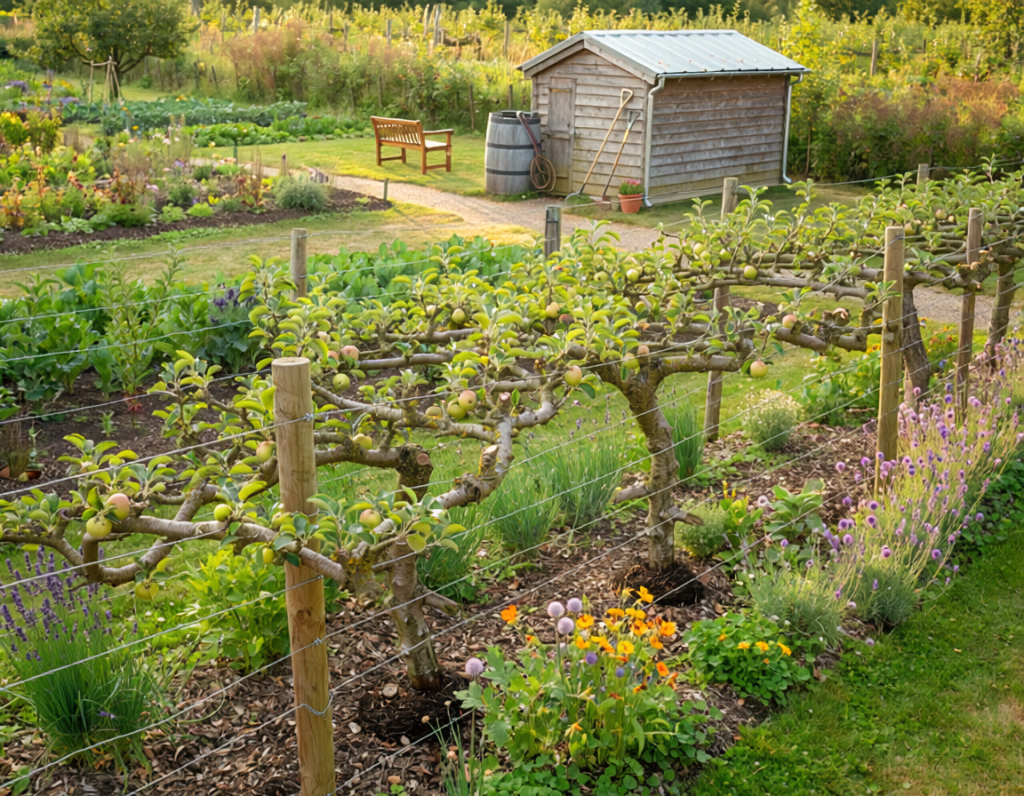
The practical benefits are real: espalier trees take up almost no horizontal space, so you can grow fruit along a narrow side yard or against a south-facing garage wall. The wall radiates stored heat at night, extending the growing season and protecting against late frosts. And because the canopy is completely flat and open, every single fruit gets full sun exposure, which means better color, higher sugar content, and more even ripening.
We work with several espalier forms—the classic horizontal cordon, fan shapes for stone fruit, and even Belgian fence patterns for those who want something truly eye-catching. These trees do require ongoing maintenance to keep them in form, which is why we offer annual training contracts.
Annual Pruning Contracts: Set It and Forget It
Look, we get it. Most homeowners don’t want to become pruning experts. You want fruit trees that produce amazing fruit, and you don’t want to think about it more than necessary. That’s exactly what our recurring annual pruning contracts are for. We come out at the right time each year, do the structural winter pruning, follow up with summer maintenance if needed, and keep your trees on track. You show up in August with a basket and a smile.
Protect Your Harvest: The Spraying Schedule
The Codling Moth Problem (And How We Solve It)
Okay, here’s the part nobody wants to hear but everybody needs to know: if you’re growing apples, pears, or cherries in Utah and you’re not on a spray program, you are going to have worms in your fruit. Full stop. It’s not a matter of if, it’s a matter of how many.
The codling moth is the villain behind the classic “worm in the apple.” The female moth lays her eggs on or near developing fruit, the larvae hatch and bore straight into the center, and by the time you bite into that apple in September, surprise. The cherry fruit fly does the same thing to cherries. These pests are endemic to the Wasatch Front and they are relentless.
A beautifully designed orchard—perfect rootstocks, amazing permaculture guilds, expert pruning—will yield nothing but ruined fruit if these pests aren’t managed. That’s the harsh reality.
How Our Spray Program Works
Our approach is precise and science-driven, but we try to keep it as low-impact as possible. Here’s the basic rhythm:
Dormant Oil Application (Late Winter/Early Spring): Before the trees break dormancy, we apply a horticultural oil spray that suffocates overwintering insect eggs, scale, and mite populations. This is about as benign as spraying gets—it’s basically just refined petroleum oil in water, and it drastically reduces early-season pest pressure.
Degree-Day Tracking: Instead of spraying on a rigid calendar, we track local degree-day accumulations. Degree-days are a measure of accumulated heat over time, and they predict insect development more accurately than calendar dates. When the math tells us the first generation of codling moth is about to emerge, that’s when we spray—not a week early, not a week late.
Targeted Systemic Applications: We use timed systemic defenses that the tree absorbs and distributes through its tissues, protecting the fruit from the inside out. These applications are carefully timed to specific windows in the pest’s life cycle for maximum effectiveness with minimum product.
All-Terrain Application: Our skid-mounted sprayers are designed to access tight backyards, navigate around garden beds and hardscaping, and deliver complete canopy coverage without damaging your turf or landscape. We integrate your orchard directly into our targeted canopy spraying routes, so it’s efficient and consistent.
The Integrated Approach
Here’s what ties all of this together: the permaculture food forest design, the proper pruning, and the targeted spray program aren’t three separate services—they’re layers of the same system. A well-designed, diverse landscape reduces overall pest pressure (biological resistance). Expert pruning opens the canopy so spray coverage is thorough and disease risk drops. And the precision spray program handles the specific pests that biological controls alone can’t manage in our region.
It’s the difference between fighting nature and working with it. We set up the system so nature does ninety percent of the work, and then we step in for the last ten percent where human intervention actually makes a difference.
Let’s Build Something That Lasts
Whether you’re thinking about a couple of fruit trees in the backyard or a full-blown permaculture food forest that transforms your property into a productive landscape, we’d love to help you figure it out. Every project starts with a conversation about your property, your goals, and what “success” looks like to you.
We’re not here to sell you a tree. We’re here to build a system—one that’s rooted in real science, designed for Utah’s specific challenges, and built to produce for decades. That’s the kind of work that gets us excited to come to your place on a Monday morning.
Give us a call or reach out through our website. We’ll come take a look, talk through the possibilities, and put together a plan that actually makes sense for your property